Your eyes are our eyes
“Your eyes are our eyes” Statement
Eiji Ōhashi
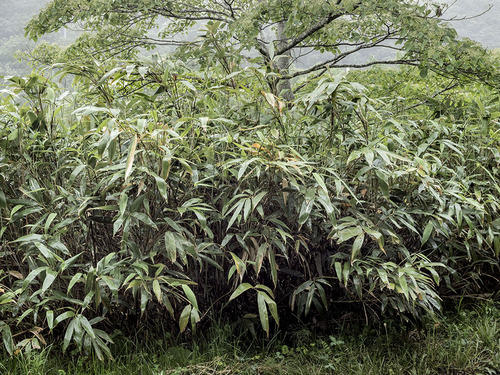
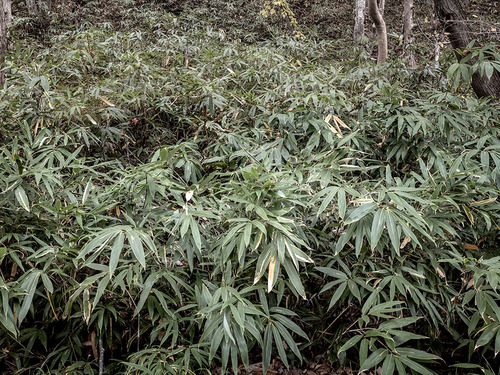
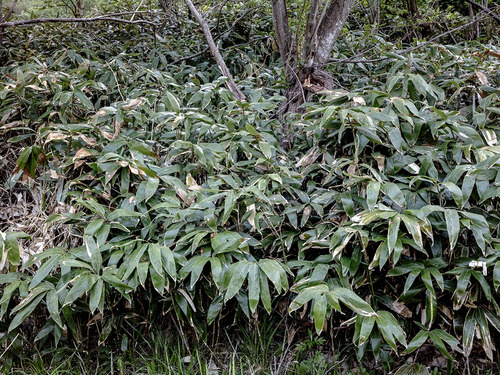
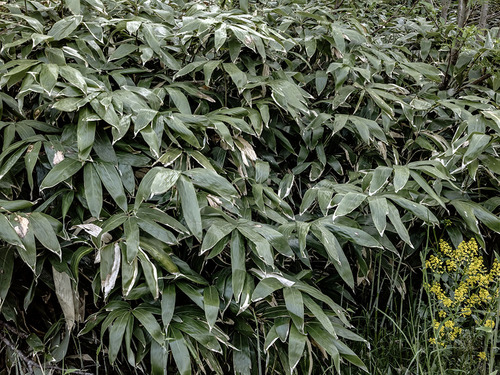
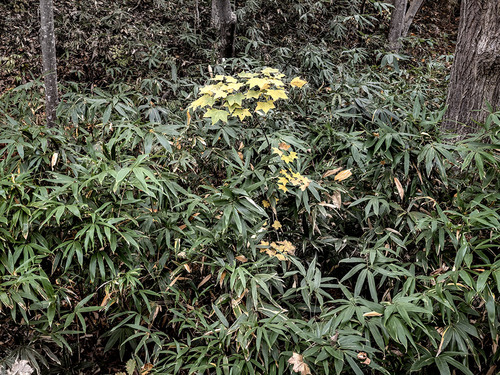
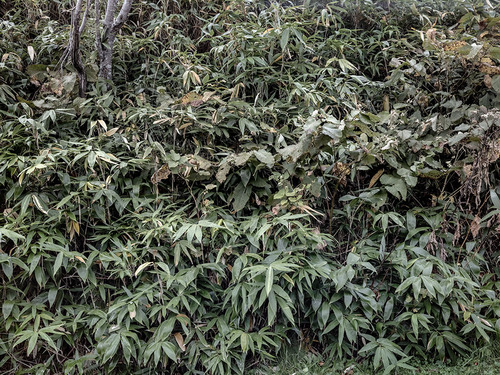
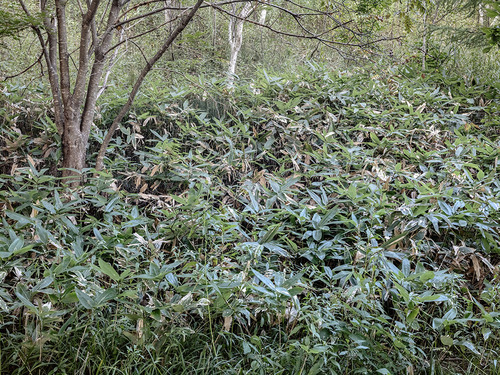
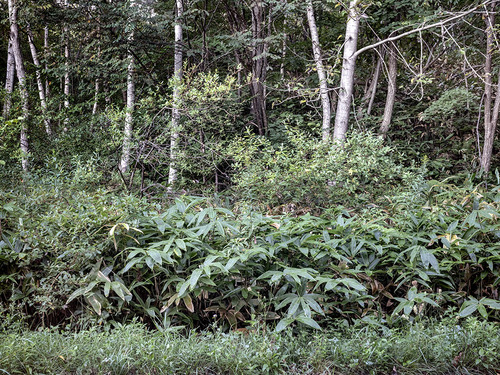
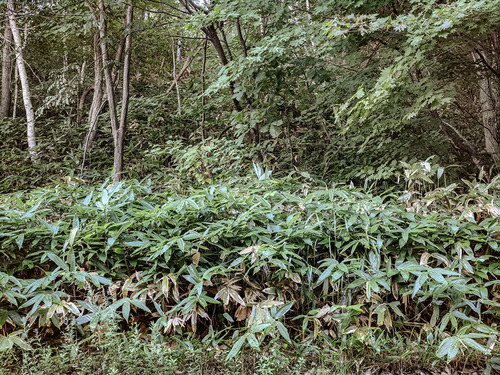
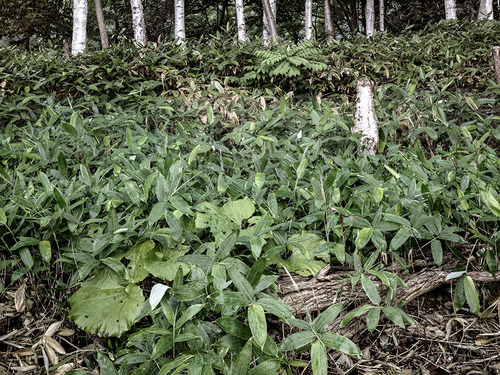
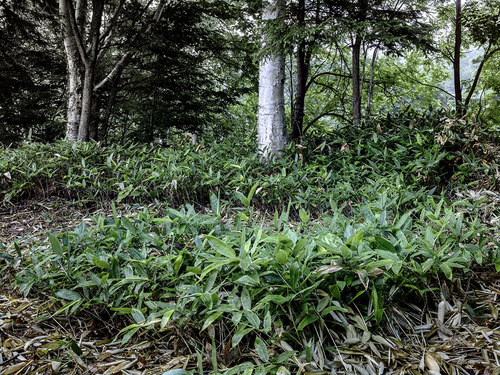
In Hokkaido, pushing through dense sasa (bamboo grass) thickets is referred to as “kogu” (to row or paddle). This expression is hard to fully comprehend unless one has actually experienced navigating such dense vegetation. Especially the “nemagaridake” (a subspecies of dwarf bamboo), which bends like a bow from the root and tangles around the feet of those walking, obstructing their path. The struggle to advance is so intense that the term “kogu” feels apt and inevitable.
During the Meiji era, convict labor symbolized this very “battle with the bamboo.” Prisoners, in their repetitive forced labor, faced a grim reality where the road ahead transformed into an endless abyss of despair. For them, the overgrown bamboo represented a symbol of unceasing forced labor and suffering.
Even today—though the prisoners and the systems that used them have vanished—the bamboo remains firmly rooted in the land. This persistent presence suggests that the logic of nature, which rejects human intervention, continues unchanged. It implies that the despair was not resolved but handed over to nature itself. While the prisoners and the penal system have disappeared, only nature’s resistance—the same that once rejected them—endures.
In 1891 (Meiji 24), when the 163-kilometer central road from Abashiri to Kitami Pass was constructed, 216 out of 1,150 convicts reportedly lost their lives. It is recorded that Kaneko Kentarō, a senior government official at the time, submitted a report titled “Inspection Report of the Three Prefectures of Hokkaido” in which he justified convict labor by stating, “Using convicts reduces construction costs, and if they die, prison costs are also saved.” Based on this logic, the government legitimized forced labor and established new penal systems to secure laborers, forcing many—especially political prisoners—into harsh labor.
On the other hand, there were also figures such as Terumae Ōinoue, the first warden of Kushiro Prison, Kosuke Tomioka, and Taneaki Hara, who were committed to protecting the human rights of prisoners based on Christian values. They were affiliated with the Doshisha (Christian) movement, and among the settlers in the Kitami region was Naohiro Sakamoto, the nephew of Ryōma Sakamoto, who sought to establish an ideal society in the northern lands.
Hokkaido’s natural landscape embraces all this history. No matter how powerful a system or how violent the oppression, within the vastness of nature’s time scale, such events are mere fleeting traces. The endlessly spreading bamboo fields—where no human figure remains—are places where traces of labor have vanished. Even though human violence has ceased, nature’s resistance continues unabated. This asymmetry is the essence of Hokkaido’s quiet landscape. The bamboo here does not symbolize healing or recovery; rather, it is evidence that despair still endures in another form.
Furthermore, recognizing that smell can evoke memories, a scent of bamboo will be recreated in the exhibition space in collaboration with perfumer Naoko Kusunoki. This sensory element links scent to photographs and memory, in an attempt to visually manifest memory through “intentional recall.”
Structure of “Your eyes are our eyes”
This artwork consists of six parts:
Traces of Touch
Traces of Touch is an attempt to visualize the traces of "touching the present nature" of this land, rather than merely recalling its past, using the technique of frottage (rubbing). The act of touching itself is preserved as memory, resisting the reduction of the prisoners' despair to a mere past event. By photographing the frottaged traces of bamboo, these material remnants are first visualized, then invalidated. This process embodies the act of “embracing and betraying materiality,” mirroring the persistent attitude of Hokkaido's land toward human actions—where human-centered perspectives are consistently subverted. This structure symbolizes that betrayal.
The 13
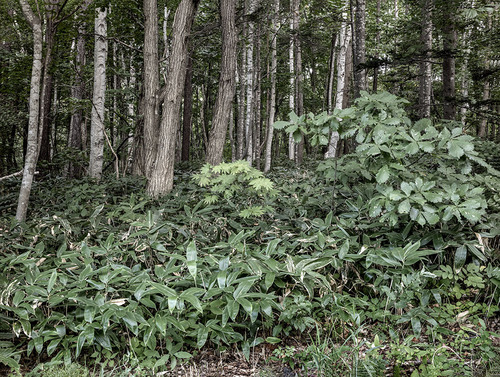
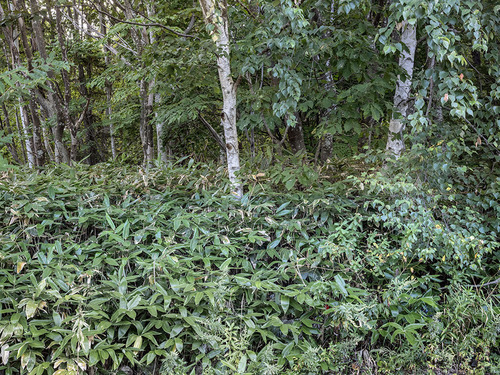
The 13 is a typological exploration of bamboo, revealing not “nature itself,” but “nature after human intervention” through subtle variations. The use of the number 13—a traditionally ominous number—hints that something once happened in this place. Adding the definite article “The” emphasizes the significance of this specific location. The number 13 refers to the temporary prisons established during the 1891 construction of the 163 km convict road between Abashiri and Kitami Pass, where many prisoners died. The image, taken in a deciduous forest in Hokkaido, uses focus stacking to produce an uncanny landscape with sharpness in every corner—beyond the grasp of the human eye.
The 13: N43°56’32” / E144°07’26” 1891
Google Earth
Google Earth is a project tracing the remnants of the convict road built in the Meiji era using current maps and satellite imagery. Today, only about 30% of the road is still in use; the rest is buried under forests and bamboo thickets, making it nearly impossible to see from the ground.
However, with the Google Earth perspective—from space—it becomes possible to detect faint traces. What is invisible from the human viewpoint is revealed from another vantage point.
Google Earth: N43°89’06” / E143°18’84” 1891
Trace of Touch: N44°02’34” / E143°50’75” 2026
Transition
Transition features images generated by AI, projected onto surviving segments of the convict road and then photographed. The AI images are based on prompts derived from the voices of current residents living along the former convict route.
By overlaying these generated images onto roads once built by prisoners, this work visualizes community sentiments of “gratitude” and “requiem” toward the prisoners. It suggests that these sentiments can “transition” into and connect with the remaining convict roads of today.
Transition: N44°02’34” / E143°50’75” 2026
Transition: N44°02’34” / E143°50’75” 1891
Historical
Historical is based on research into the background of the convict road construction and the people involved. It includes rare materials such as photographs of the home of Tazō Satō (the only surviving temporary prison—No. 9), and gravestones of prisoners washed away in the 1900 flood.
It also includes portraits of key figures like Terumae Ōinoue, the first warden of Kushiro Prison, known as a “notable warden” for his reform efforts, and Kosuke Tomioka, the only prison chaplain who left records of the convict road construction. This work quietly shines a light on individuals erased by the harshness of history.
Location: Tazō Satō residence, Setose, Engaru (Site of Prison No. 9)
Photogram of Return
Photogram of Return uses the photogram technique to directly imprint bamboo onto photosensitive paper. By layering multiple bamboo shoots and covering the entire frame, the piece expresses “the inescapable strength of nature.”
Once rooted, bamboo is extremely difficult to remove, obstructing the expansion of farms and settlements—thus, often called a “natural wall.” The shapes etched in light symbolize the tenacity of nature and its overwhelming presence that envelops human activity.